
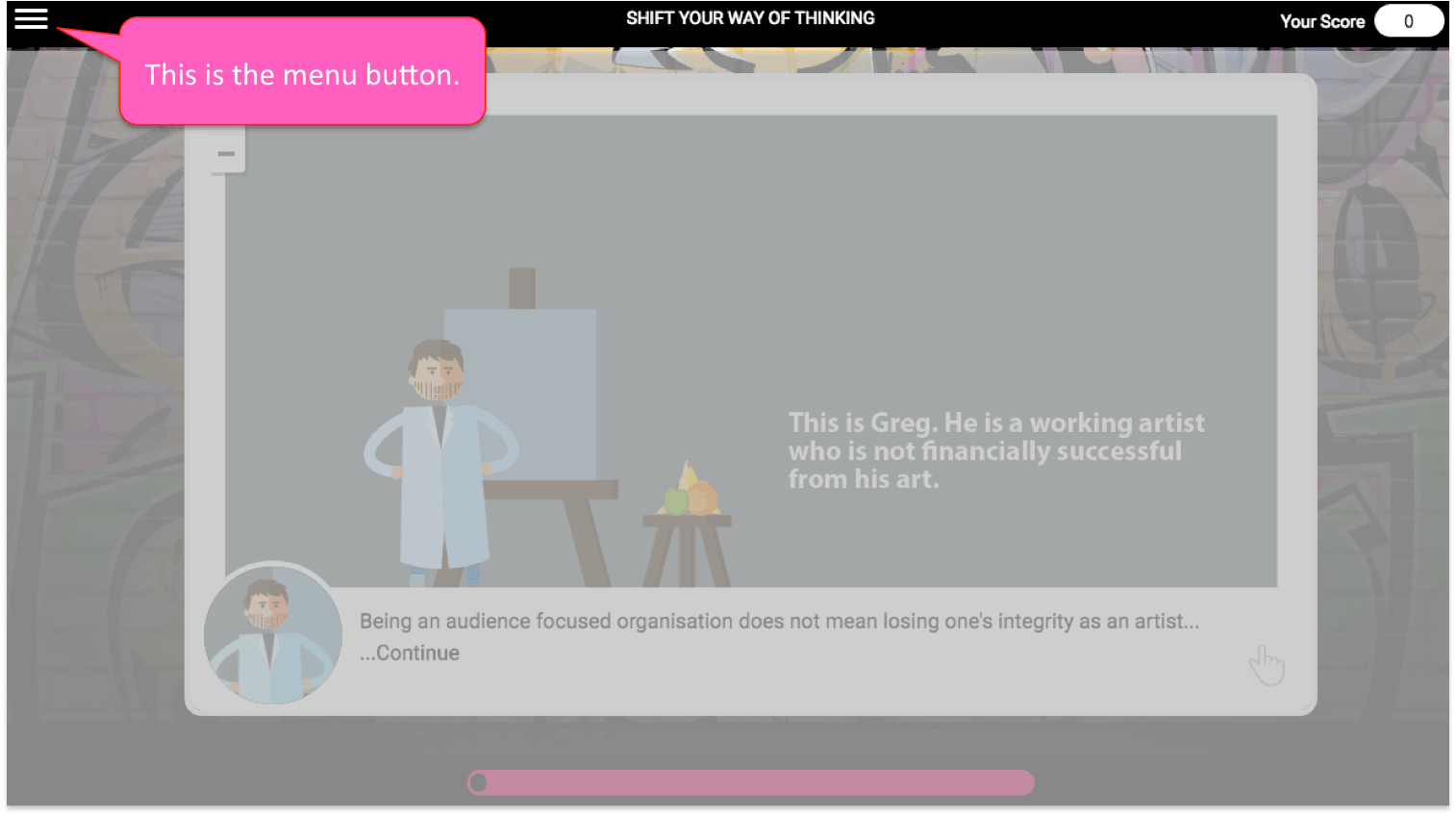
This is the menu button. You will find a list of chapters, downloadable resources and sound settings here. Click on the next heading above, to see the menu list.
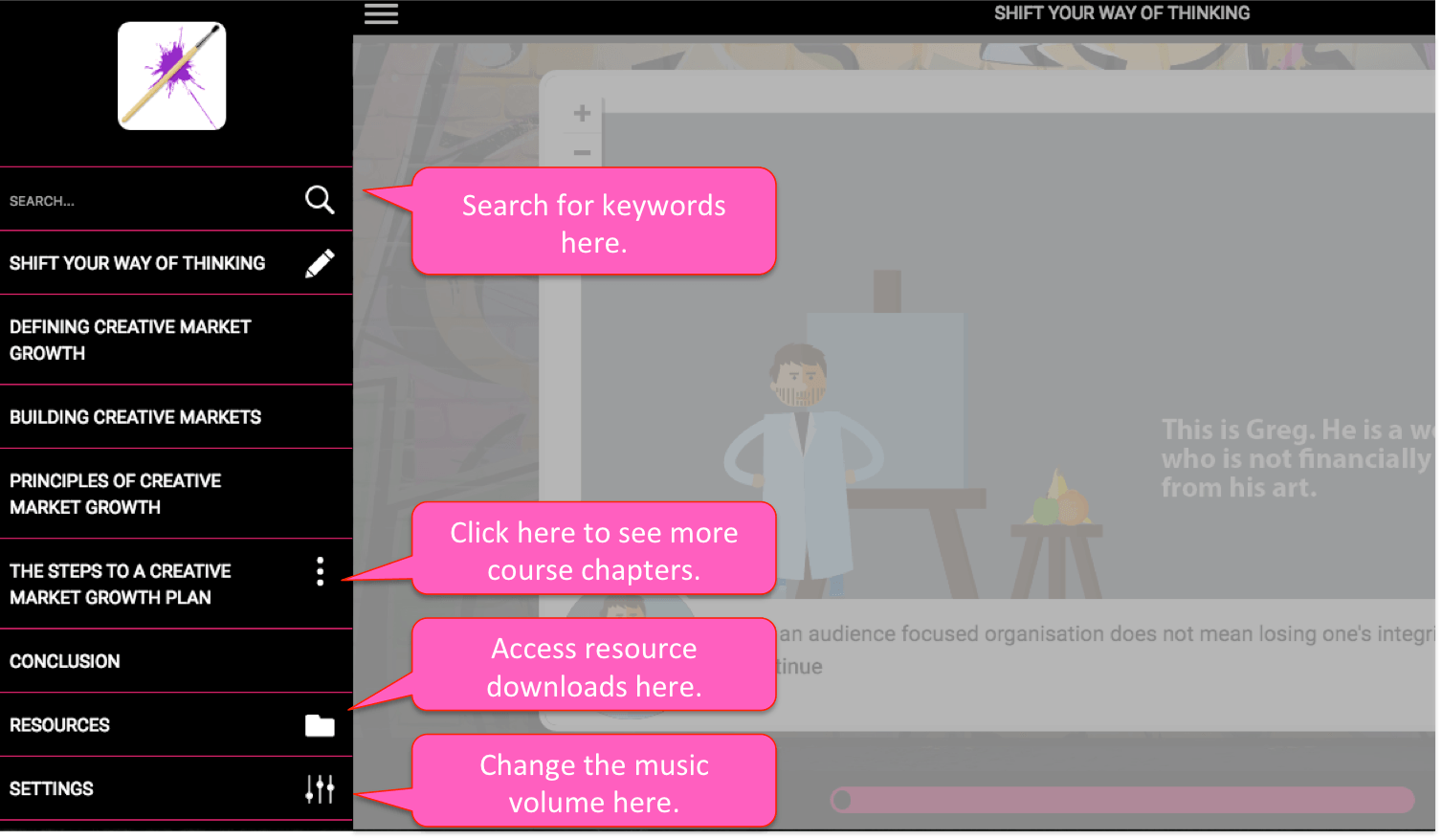
Take a moment to familiarise yourself with the menu list. To close the menu, you can click anywhere on the learning page. Next, click on the glossary tab above to see where you will find the glossary.
To access the glossary, you can click on the glossary button. To close the glossary, you can click anywhere on the learning page. Next, click on the navigation arrows tab above to learn how to move between pages.

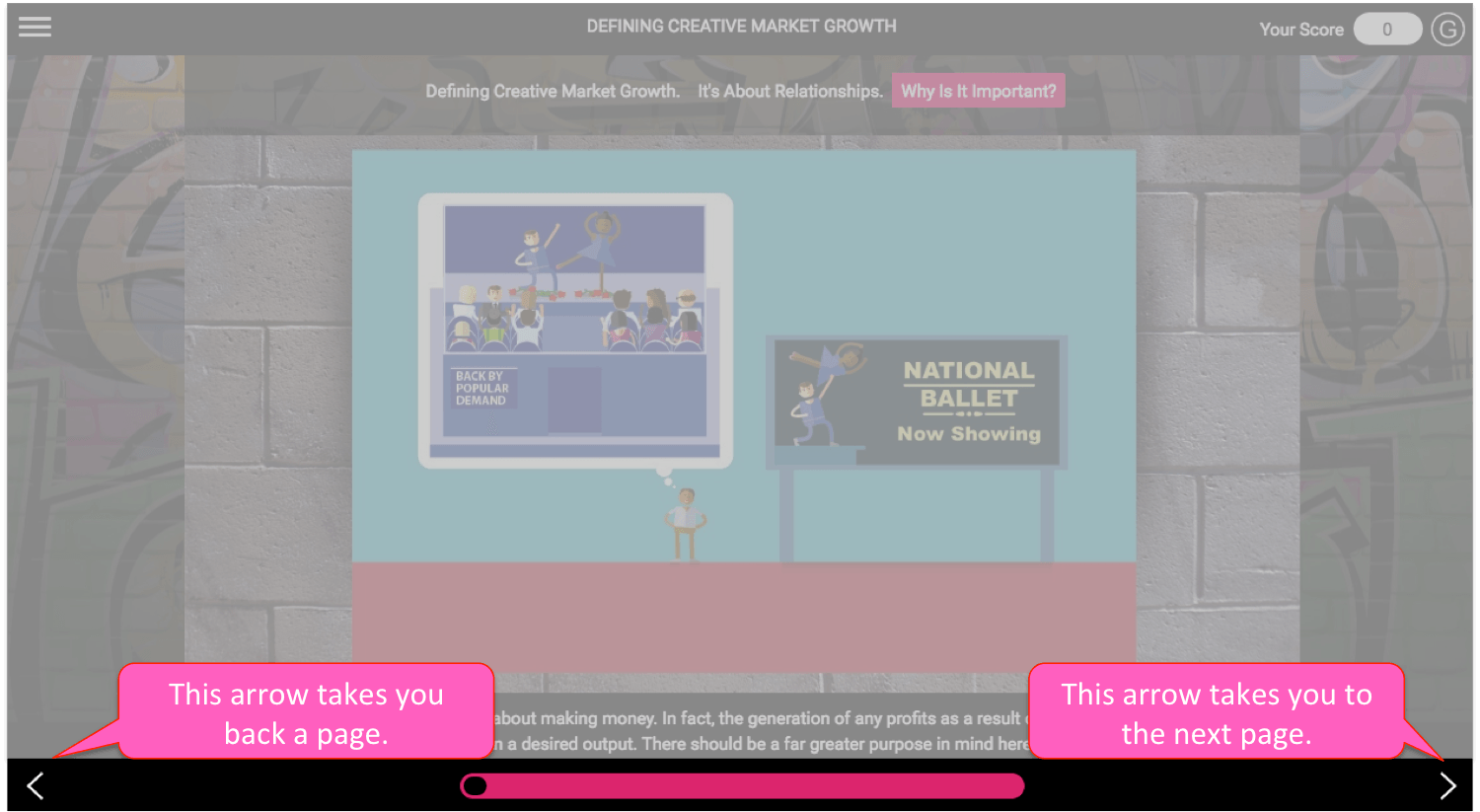
These are the navigation arrows. You would click on the right arrow to move forwards. You would click on the left arrow to move backwards.


Essentially the goal of creative market growth is to build creative markets, viewership, listeners, consumers etc. However, it is not just about building new markets; it is also about retaining and nurturing your relationships with your current market.
When we talk about building creative markets , we are describing one or more of three activities:


To do this you need a clear understanding of your current and potential markets, as well as put a long-term plan in place on how to develop them.
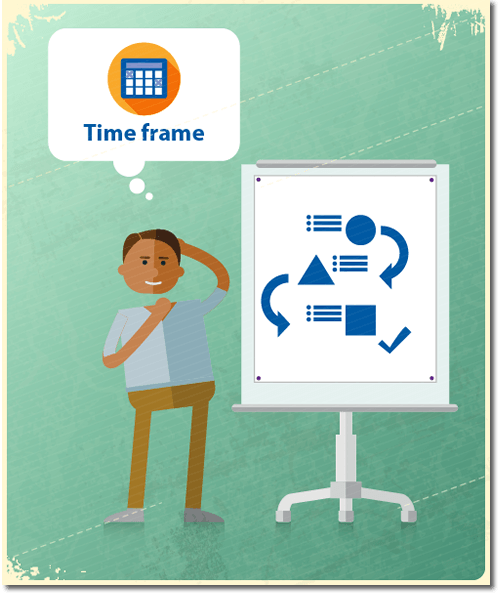

Principle one:

It is a long term plan – set a time frame to it e.g. 5 year plan.

Principle two:
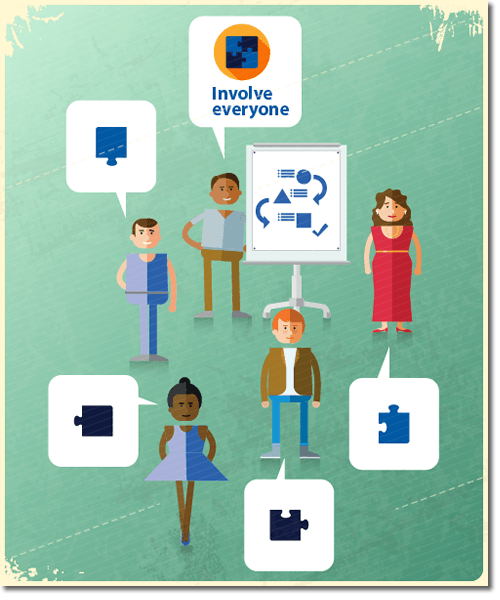
It will require organisation-wide commitment – everyone should get involved and be aligned to what the plan is trying to achieve.


Principle three:
It needs to address your existing creative markets and potential markets –identifying, segmenting and communicating to these segments.

Principle four:
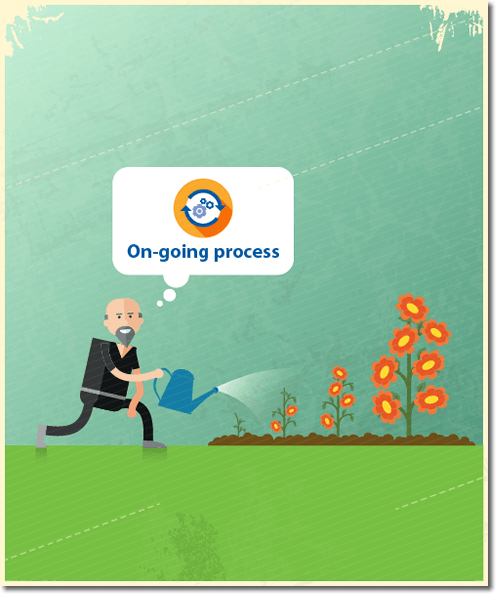
Growing your creative markets is an on-going process, not a short-term project – you need to constantly be thinking about and driving the growth of your markets.


Principle five:
Once your plan is implemented, you need to continuously evaluate the results and review your plan – you may need to adapt your plan from time to time.3
Match The Principle
Take a moment to reflect on the key principles you should keep in mind when putting together your creative market growth plan. Can you identify which visual accompanies the principle? Select, drag and drop one of the five visuals in the principle box. |


| Your creative market growth plan should be a long term plan. |
Match The Principle
Take a moment to reflect on the key principles you should keep in mind when putting together your creative market growth plan. Can you identify which visual accompanies the principle? Select, drag and drop one of the five visuals in the principle box. |
| Your creative market growth plan will require organisation-wide commitment. |
Match The Principle
Take a moment to reflect on the key principles you should keep in mind when putting together your creative market growth plan. Can you identify which visual accompanies the principle? Select, drag and drop one of the five visuals in the principle box. |
| Your creative market growth plan needs to address your existing and potential creative markets. |
Match The Principle
Take a moment to reflect on the key principles you should keep in mind when putting together your creative market growth plan. Can you identify which visual accompanies the principle? Select, drag and drop one of the five visuals in the principle box. |
| Growing your creative markets is not a short term project. |
Match The Principle
Take a moment to reflect on the key principles you should keep in mind when putting together your creative market growth plan. Can you identify which visual accompanies the principle? Select, drag and drop one of the five visuals in the principle box. |
| Once your creative market growth plan has been implemented, you should continuously monitor your results and adapt your plan where needed. |
True/False
Essentially the goal of creative market growth is to build creative markets, viewership, listeners, consumers etc. This refers to building new markets only.
True/False
Creative market growth is purely about commercialising your product. The desired result of such growth activities should be the generation of profits.

Summary Notes
- Creative market growth is about developing on-going relationships with current and potential creative markets.
- The purpose of creative market growth is not just about making money, but rather about sustaining your work and giving it the best platform.
- Building creative markets involves broadening, retaining and deepening, and diversifying them.
- Developing your creative markets requires a long-term creative market growth plan; it is not a short term project.
- Your creative market growth plan should address your existing and potential creative markets; once implemented, it should be continuously evaluated and adapted where needed.
- Your creative market growth plan requires organisation-wide commitment.
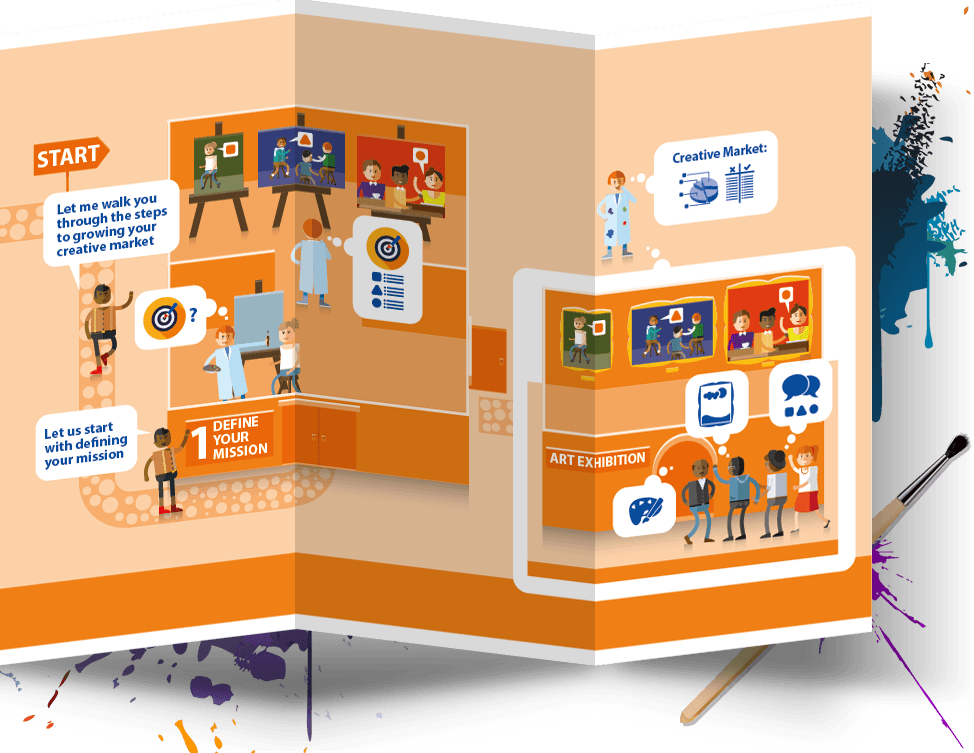
What your mission is will influence your creative market growth plans and activities. It will help you define your creative markets and recognise when change is needed.
Art Township International - mission statement


Strengthen, create, manage, and promote creative projects that contribute towards the development of local arts, the economy, communities and international relations.
To be a township and urban art experience bridge, setting up and capacitating communities to run Community Creative Districts, such as Arts Maboneng Township Experience.4

Worksheet exercise
Complete exercise one, to help you define your mission.
Create a vision of the type of creative markets your work needs to reach (who should/could your creative work appeal to?) and how you would like your markets to interact with / interpret your work.5
In doing so, you should then be able to identify what your objectives (goals) are. In other words, what would you like to achieve as a result of your creative market growth activities.
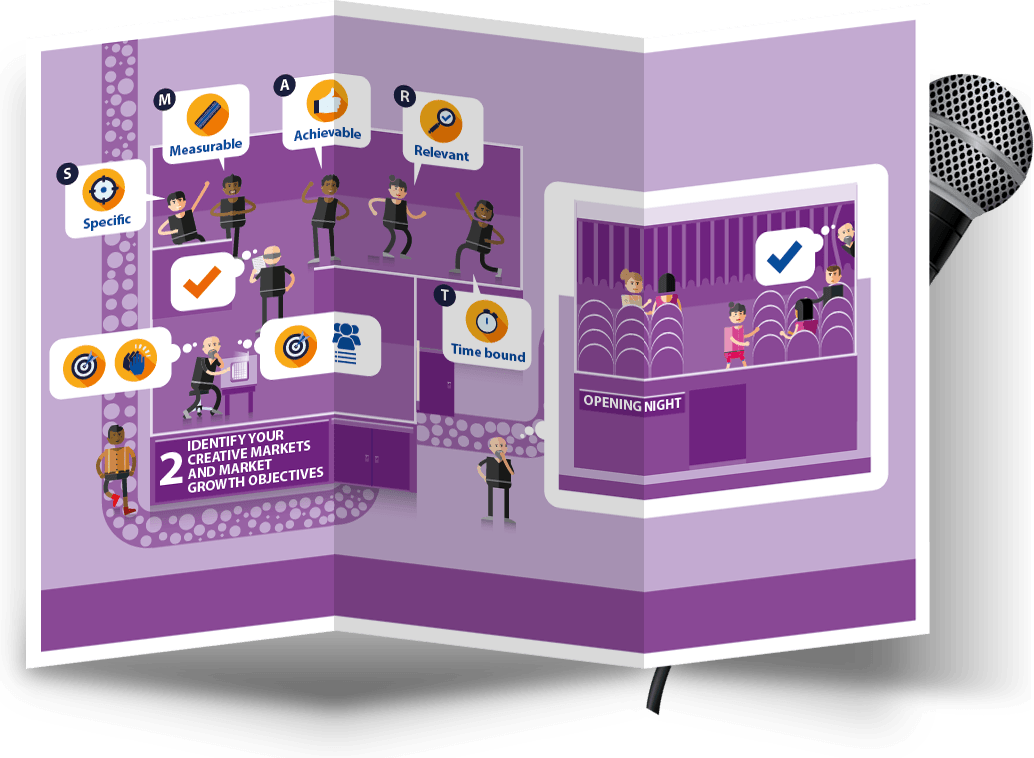


Flying House6 - SMART objectives
Flying House is a non-profit collective of arts professionals based in Joburg, dedicated to securing better income generation opportunities for performing artists. Here are select objectives of Flying House’s launch event:
- Create visibility for Flying House and its activities through the launch event, directly with 90-130 participants and audience members at the launch, and indirectly via word of mouth (before, during and after the launch) and media, the impact of which is to be monitored throughout May 2015 to March 2016.
- Conduct further market research at the launch and throughout the project (May 2015 to March 2016) regarding stakeholder opinions about the Flying House concept to inform planning and operations subsequent to the launch. Our research target is to collect data from 200-300 individuals with balanced representation from all our stakeholder groups.
- Recruit 30-40 initial members at or through the launch event, by 31 March 2016.

Worksheet exercise
Complete exercise two, and craft your creative market development objectives.
Goals should be SMART
Knowing where you want to be in the long term will help your short-term decision making. Your objectives should be SMART. Can you remember what SMART goals look like?
Question 1
A goal that uses definite numbers and values makes it...
Question 2
A goal that avoids vague, subjective wording makes it
Question 3
A goal that is action-oriented makes it...
Question 4
A goal that takes place in a specific timeframe makes it...
Question 5
A goal that is applicable and realistic makes it
Summary Notes
When putting together your creative market growth plan:
- Start with defining your mission - what you are trying to achieve/reveal with your work.
- Create a vision of the type of creative markets your work needs to reach and how you would like your markets to interact with/interpret your work.
- Identify your SMART objectives.
In order to assess the real potential for your creative markets, you need real evidence on these markets (both current and potential). By real evidence, we mean information that has purposefully been collected.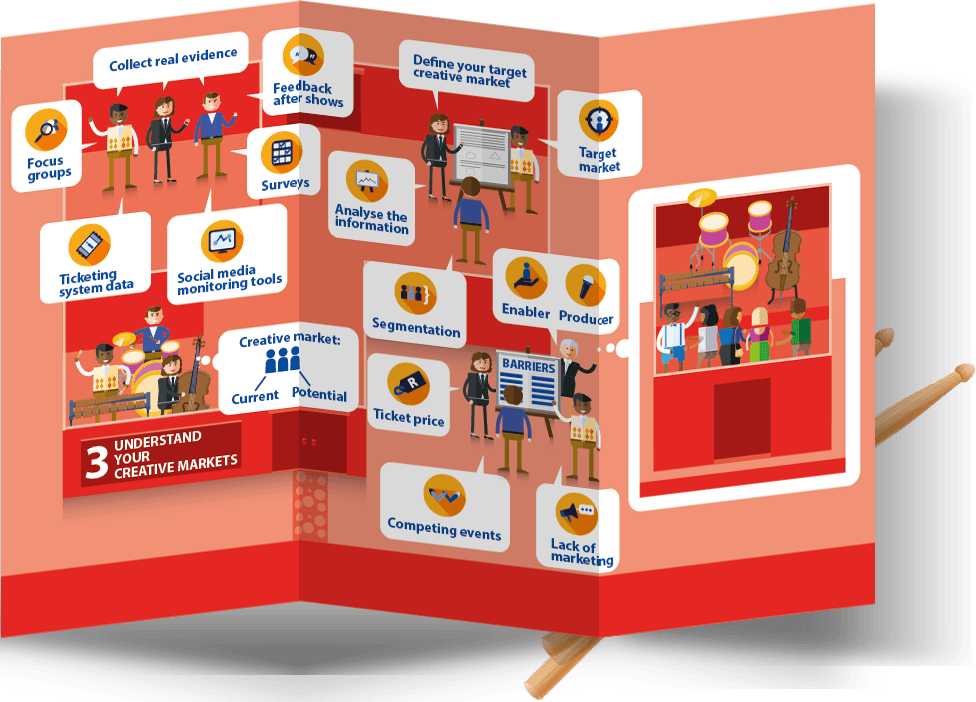

Competitors: who are they; where are they; what are their strengths/weaknesses.

Current creative markets: overall trends, patterns of engagement, insight on behaviours and attitudes, knowledge of needs, demographics, contact details, opinions/reactions.

Potential creative markets: location, profiles, preferences and barriers/motivations.
The type of market information you collect may also be dependent on when you plan to collect your evidence, e.g. collecting information before creating your creative work, versus collecting information after the work has been created.
You should aim to collect a combination of quantitative and qualitative evidence.

Worksheet exercise
Complete exercise three, to analyse your competitors.
Data Collection Methods
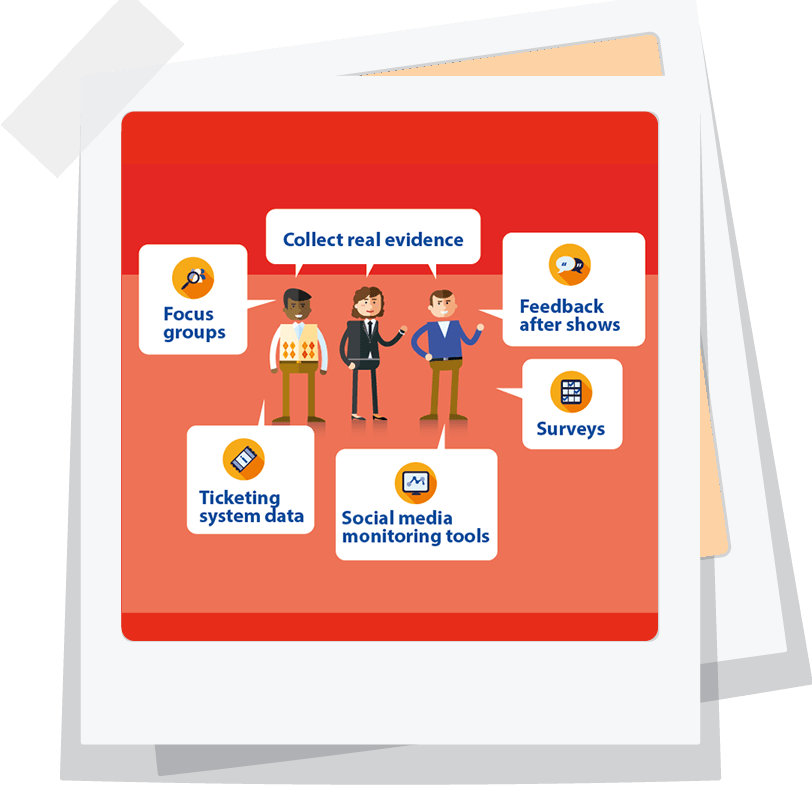
There are various ways in which you can collect this information. Your needs and the resources you have available to you, will determine which methods are most suitable to you.
However, this is also an opportunity for you to be innovative and creative in collecting the information you need. A lack of funds or resources doesn’t have to be the reason for not being able to gain access to the information you are looking for.
Begin to think from a place of asset based opportunity and collaboration and not from a “needs” based way of thinking.
As mentioned previously, there are various ways in which you can collect the data you need. If you would like some ideas of what data collection methods are available, along with the pro's and con's of each, click on the link below:
Download data collections method pdf
This is by no means an exhaustive list, but it may spark some new data collection method ideas of your own. When putting together your own list of options, it may be useful to think of the pros and cons of each to help you choose the best methods. Of course, the type of evidence you are looking for and hence the questions you need to ask will also impact the type of data collection method you choose.
Worksheet exercise
Complete exercise four, where you put together your data collection plan.
Segmentation
Once you have gathered your evidence, you then need to carefully analyse the information.
The results of your analysis should then enable you to segment your market accordingly.
Segmentation – the process of defining and subdividing a large homogenous market into clearly identifiable segments, having similar needs, wants or demand characteristics.7
Steps for segmenting your market:


First, list the different segments that you can identify in your evidence.
Gauge the needs of each segment, based on their profiles.8
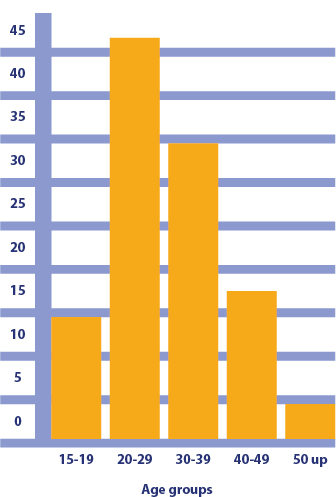
What is your age group?
| Age Bracket | Responses | |
| Option 1 | 15 to 19 | 10 |
| Option 2 | 20 to 29 | 42 |
| Option 3 | 30 to 39 | 30 |
| Option 4 | 40 to 49 | 13 |
| Option 5 | 50 and older | 5 |
How often do you attend the Movie in the Park events?
| Attendance levels | Responses | |
| Option 1 | First time | 60 |
| Option 2 | 1-3 times a year | 40 |
| Option 3 | 4-6 times a year | 0 |
| Option 4 | 7 or more a year | 0 |
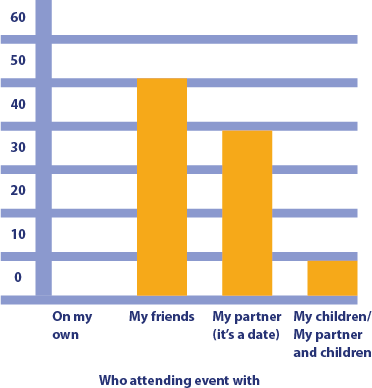
Who is at this event with you?
| Attending (with) | Responses | |
| Option 1 | On my own | 0 |
| Option 2 | My friend(s) | 50 |
| Option 3 | My partner (it's a date) | 40 |
| Option 4 | My children / My partner and children | 10 |
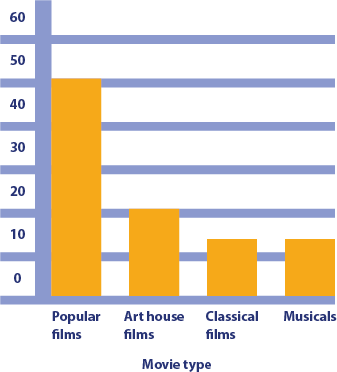
What type of movie would you most prefer to see?
| Genre | Responses | |
| Option 1 | Popular movies | 50 |
| Option 2 | Art House movies | 20 |
| Option 3 | Classical movies | 15 |
| Option 4 | Musicals | 15 |
Target Market
Once you have segmented your creative market you should then be able to identify who your target market is. Target market – a particular group at which a product is aimed.
Think back to the creative market you identified in step 2, as this will guide you in determining who your target market is and that it is aligned to your objectives.
Focus on a target market that is receptive to your work and organisation, and that makes sense for you to pursue.


Barriers

Your analysis may also bring to light the possible barriers your target market faces.
These could include matters such as product pricing or where you choose to present your work, or even people’s perceptions and their experience of your work.
You need to consider these barriers and thereafter look at how you can address them appropriately. Perhaps even remove some completely, using innovative strategies to accommodate your creative markets.9
Analyse responses to question one
This graph shows the spread of responses according to the respondents' age groups. As you can see, the age of the respondents varies and ranges from 15 years and older.
What important information can Movie Mania take away from this graph?
Analyse responses to question two
This graph shows the spread of responses according to the number of events attended. Currently, Movie Mania holds 11 events a year. However, if you look at the graph, do you notice that none of the respondents have attended more than 3 events a year. Think about what this could mean for Movie Mania.
Based on the information in this graph, how could Movie Mania segment its creative markets?

Analyse responses to question three
This graph shows the spread of responses according to who they attended the event with. Do you notice that none of the respondents attended the event on their own?
Based on the information in this graph, how could Movie Mania segment its creative markets?
Analyse responses to question four
This graph shows the spread of responses according to the type of movies preferred. Currently, Movie Mania shows classical movies at the events. However, if you look at the graph, do you notice that most respondents do not prefer to watch classical movies, yet they have still chosen to attend the event. What do you think this information could mean for Movie Mania?
Based on the information in this graph, how could Movie Mania segment its creative markets?
Identifying Movie Mania's target market(s)
- Segment 1: 20 to 29-year-olds who are not married and enjoy spending time out with their friends. This segment enjoys live music and socialising with others. This segment prefers popular movies.
- Segment 2: 30 to 39-year-olds who are married or in a committed relationship and who enjoy spending quality time with their partners. This segment also enjoys live music. They also prefer to watch popular and classical romance movies.
Question 1
Segment 1 is a larger market than segment two, but both have great growth possibilities. Which segment should Movie Mania target?
Question 2
Both segments offer great potential profits. Movie Mania's current loyal customer base (attend more than once) sit in segment 2. Which segment should they target?
Question 3
Currently, Movie Mania has the resources and skills to market to both segments. Which segment should they target?
Question 4
Movie Mania's key objective is to grow its audience, as well as to service its current audience better. Based on this objective, which segment should they target?
Summary Notes
- In order to understand your creative markets (existing and potential) you need to collect real evidence on these markets.
- You should aim to collect a combination of quantitative and qualitative evidence.
- A lack of funds or resources doesn't have to hold you back from gathering the data you need; think
from a place of asset based opportunity and collaboration. - Once you have gathered your data you should segment your creative markets.
- Keep in mind the criteria you should consider when evaluating which creative market segment(s) to target.
At this
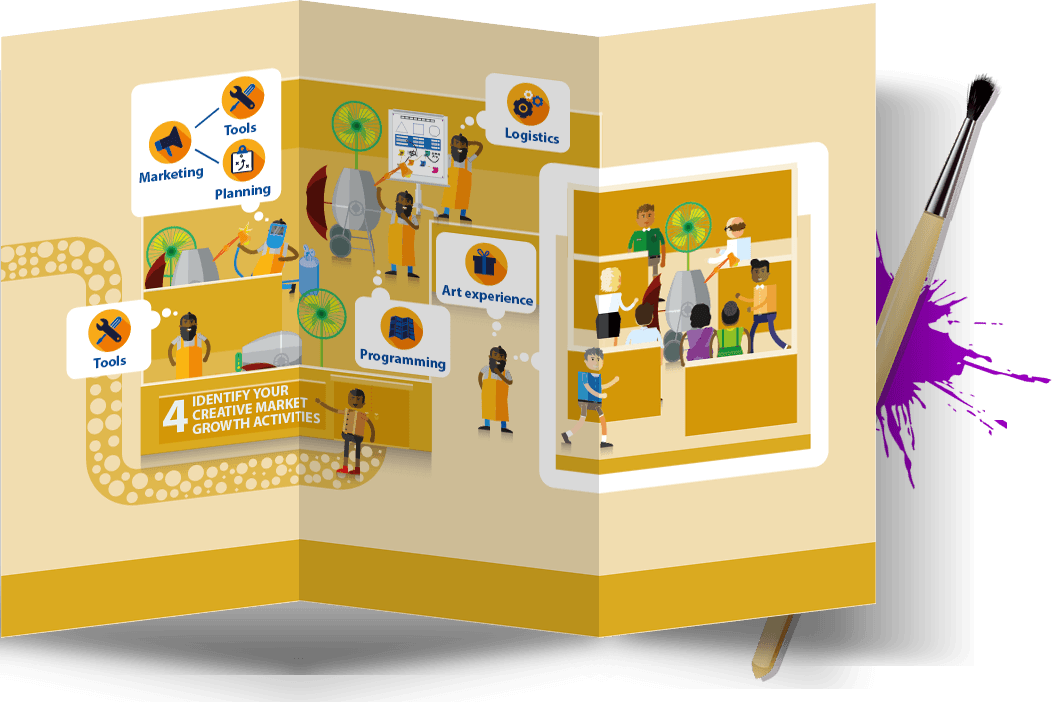
Creative market growth is not just about how you market your product to your target group. It could also include how you put together your programmes, how you choose the right venues or the use of specific language to communicate with your target group. Your mission and the objectives you set in step 1 and 2 will also inform these activities.
When planning these activities you need to explore the tools you could use, as well as how you are going to use them.
Marketing

When planning your marketing activities, keep the following in mind:
- The marketing tools used should reach your target market;
- Your marketing messages should be positioned correctly and align with your mission;
- When to market your work;
- Refer to the
12 week marketing checklist example in the resource list.
There are various marketing tools you could use to reach your creative market:

- Social media – facebook, instagram, youtube, twitter (be strategic on how you want these tools to work for you). To learn more, refer to the Social Media Strategy document in the resource list.
- Leveraging word-of-mouth in your arts community
- Utilising your venue’s advertising space
- Print flyers
- Sponsored adverts
- Collaborate with other businesses / campaigns that you share a market with and that is mutually beneficial

Portal 201610
Here is an example of a media release that was done for the performance event, Portal. The Ar(t)chive initiative was used as a marketing platform to create awareness for the event.



Doing Hair: Art and Hair in Africa. A partnership between Black Like Me (BLM) and Wits Art Museum (WAM)11
Hair is a subject that is universally relevant and thus accessible. There are also more than 50 hairdressing salons in WAM’s immediate neighbourhood providing ready marketing channels. The partnership between WAM and BLM was formed in order to grow new audiences for the museum from the immediate Braamfontein community as well as those further afield. Hairstyling is a highly creative enterprise and BLM was excited to be associated with the creativity and innovation that is inherent in the visual arts.
Benefits to WAM:
- financial support = market the event more effectively
- new visitors to WAM
- Over 6000 people visited the exhibition
- Great exposure to the surrounding community due to the effective marketing
Benefits to BLM:
- brand awareness to the student population of Wits University
- value add – authentic product placement, as their branding was used as part of the exhibition and marketing
- great brand exposure
Explore The Benefits
Doing Hair: Art and Hair in Africa. A partnership between Black Like Me (BLM) and Wits Art Museum (WAM)
There were various benefits that Wits Art Museum (WAM) and Black Like Me (BLM) realised as a result of their partnership. Can you remember which benefits were realised by WAM? Select 3 benefits from the list below.
- Financial support allowed for more effective marketing of the event
- Great brand exposure
- Value add - authentic product placement
- New visitors
- Great exposure to the surrounding community due to effective marketing
- Brand awareness to the WITS student population
Programming

How you put your programmes together and the type of programmes you design need to be aligned to the type of creative market you are looking to attract.
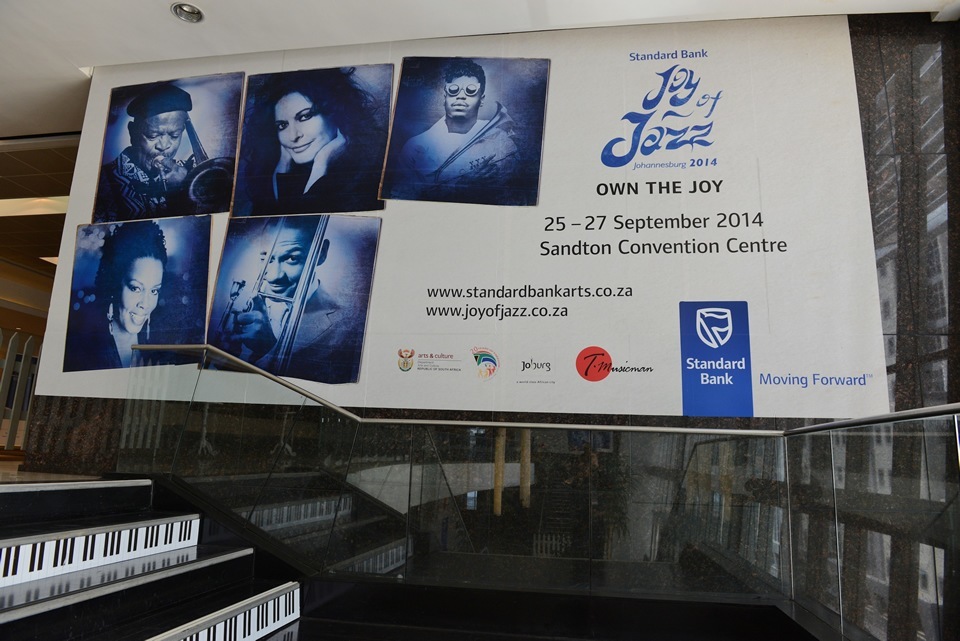
Standard Bank Joy of Jazz. A partnership between The Standard Bank of South Africa and T Musicman12
Musically, the partnership has exposed South African audiences to some of the jazz greats from across the globe, South
Each year the Standard Bank National Schools Big Band and the Standard Bank National Youth Jazz Band perform at the festival, and the Standard Bank Young Artist For Jazz is given headline status and exposure to a very large audience. The partnership is probably one of the most significant for sustaining and growing jazz in South Africa.
Logistics

You also need to carefully consider how you are going to get your work to your market (or your market to your work).
Your profile of creative market members will influence the type of venue you choose and where your venue is located.

First Thursdays - logistics13
Regular opening hours of galleries restricts potential audiences who are not able to attend during the day. First Thursdays sees a collaboration between galleries and other venues in close proximity to one another to shift their regular logistics and make themselves accessible to different audiences once a month.
Art Experience

It is also important to consider that for the creative market, it may not just be about seeing the work but also about the experience itself.
Your target market will influence the type of experiences you create to ensure that your market interacts with your work in the way you have envisioned it.
Nelson Mandela Capture Site. A partnership between nMngeni Municipality and Culture Mechanics14
The partnership was developed to establish an important heritage and cultural site which marks a significant moment in history, the arrest of Nelson Mandela. Through the development and installation of the sculpture, a world class sculpture was created which attracts up to 700 people a day, stimulating the local tourist economy along the Midlands Meander, the establishment of a craft and business incubator at the site, as well as providing conferencing facilities to local business.
The project was realised through a mutually beneficial relationship between a Municipality and a cultural heritage company to develop and stimulate a micro economy within the Midlands Meander through the installation of a large scale iconic sculpture, images of which have gone viral on social media networks as well as being documented in international design and architectural journals, websites and magazines. Through a successful art project, a long term tourism initiative has been developed which has in the short term already increased tourism. Howick and the Capture Site has further instilled itself as a tourist attraction in KZN. The project and partnership is long term and its aim is to continually upgrade the facilities to create a place for people to gather and remember our history. The fact this is part of the Midlands Meander also contributes to the overall experience of the visitors.

Worksheet exercise
Complete exercise five, where you can identify some creative market development activities based on what you may already know about your target market.
Take A Quick Break
Well done on completing four of the five steps to putting together a creative market growth plan. Before you continue with the fifth and final step, why not take a quick break and complete this word search.
In this chapter, we looked at examples of market growth activities. Can you find some of these examples in the puzzle below?
Summary Notes
- Creative market growth is not just about how you market your product to your target market, it can also include how you put together your programming, logistics, and art experience.
- Your mission and objectives set in step 1 and 2 will also inform these activities.
- While some market growth activities require a healthy amount of funds, there are other options you could pursue which don't require a lot of money or resources. This is an opportunity to get creative.
When putting your creative market growth plan together, it is important to involve everyone at the organisation. “Effective market building requires all hands on deck – staff members can serve as the organisation’s eyes on the ground, noticing things that people in management or the artistic divisions do not.”15 Share your research with all staff members, so that they can all learn from the findings and act accordingly. This approach is also useful when you don’t have a dedicated staff resource to plan and implement a creative market growth plan.


Once you have put your creative market growth plan together you need to share it with the rest of your organisation, to ensure that everyone is aligned to what the organisation is trying to achieve. Make sure organisation leaders and staff understand and embrace the strategy and their roles in it.
An example of how to involve the organisation:
Introduce lunch break discussions tied to upcoming productions, where all employees in the arts organisation are free to participate. Use this time to talk about the productions and enable them to get an “elevator pitch” that they can share with others who may be interested in attending.16 (i.e. use your staff members to tap into creative markets).
Conclusion
“Sustaining what art offers the human spirit and human interactions”17 is the reason why creative workers and organisations alike should participate in creative market development to ensure further engagement with the creative sector.
When crafting your creative market growth plan it is important to think long term. Market growth should be an on-going process, which is shared across the organisation; your plan must have a holistic approach and should be continuously evaluated and reviewed. Ultimately market growth is about building relationships with your existing and potential target markets. To do this you really need to know your markets, so that your market growth activities are properly aligned, and therefore enable you to realise your mission.